
Why App Development & Enterprise Mobile Apps Are Essential in the UAE
In today’s hyper‑connected business landscape, mobile apps are no longer a luxury—they are the backbone of customer engagement, operational efficiency, and brand differentiation. For companies in the UAE, robust app development has become a strategic priority, especially as digital‑first initiatives support the nation’s broader smart‑city and cloud‑first vision. At the heart of this transformation, enterprise mobile app builders such as The ADMM are emerging as trusted partners, helping UAE‑based organizations design, build, and scale secure, high‑performance mobile solutions tailored to local markets and global ambitions.
Understanding App Development in the UAE Market

App development refers to the end‑to‑end process of designing, coding, testing, and deploying mobile or web‑based applications that solve specific business or user problems. In the UAE, app development has evolved beyond simple utility tools into sophisticated platforms that integrate AI, cloud services, biometric authentication, and real‑time analytics. Government entities, banks, retail chains, healthcare providers, logistics firms, and startups all rely on custom apps to streamline operations, improve transparency, and enhance user experience.
Modern UAE app development projects typically follow an agile methodology, combining UX research, prototyping, development sprints, and continuous feedback loops. Developers must also adhere to local regulations such as data‑privacy standards, EMV compliance for payment apps, and cybersecurity requirements, especially in sectors like fintech and healthcare. Leading development agencies in Dubai and the wider UAE focus on building cross‑platform apps (iOS, Android, and sometimes web) that perform seamlessly on low‑ and high‑end devices, keeping in mind the region’s diverse user base and connectivity patterns.
Why Enterprises Need an Enterprise Mobile App Builder
An enterprise mobile app builder is a specialized platform or service that allows organizations to design, assemble, and deploy complex mobile applications without relying entirely on low‑level coding. For large companies, this is essential because traditional app development can be slow, expensive, and difficult to maintain across multiple platforms and departments. With an enterprise‑grade app builder, businesses can centralize logic, reuse components, enforce security policies, and accelerate deployment cycles.

Enterprise‑oriented app builders typically offer features such as:
-
Pre‑built templates and UI components for faster prototyping
-
Role‑based access control and secure authentication
-
Integration with existing CRM, ERP, and cloud systems
-
Analytics dashboards to track user behavior and performance
-
Over‑the‑air updates and centralized deployment management
These capabilities are especially valuable in the UAE, where enterprises often manage multi‑branch operations, thousands of employees, and millions of customers across different Emirates and international markets. By using a professional enterprise mobile app builder, organizations can reduce technical debt, standardize user experiences, and iterate quickly based on real‑world feedback.
The ADMM: Your Trusted Enterprise App Development Partner in the UAE
The ADMM has positioned itself as a one‑stop partner for businesses seeking streamlined app development and full‑cycle digital services in the UAE. With a strong foothold in the region’s business‑setup and digital‑transformation ecosystem, The ADMM offers enKey Benefits of Enterprise Mobile App Development for UAE Businesses
Implementing an enterprise mobile app strategy in the UAE offers several tangible advantages, particularly for companies that operate in competitive sectors such as retail, logistics, real estate, and financial services.
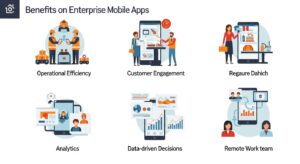
Improved Operational Efficiency
Mobile apps can automate routine tasks such as inventory management, delivery tracking, employee attendance, and field‑service reporting. For example, a logistics company can use a mobile app to assign deliveries, track driver locations, and update customers in real time, reducing paperwork and minimizing errors. Similarly, retail chains can use mobile‑based POS and inventory tools to keep track of stock levels across multiple outlets.
Better Customer Engagement
Customer‑facing apps allow UAE businesses to build stronger relationships by offering personalized experiences, loyalty programs, push notifications, and in‑app support. A restaurant group can let users book tables, order food, and earn rewards; a real estate agency can provide virtual tours, chat with agents, and track property listings—all from a single app. This level of engagement increases retention and boosts average order values.
Data‑Driven Decision Making
Enterprise mobile apps can collect rich usage data, such as which features are most popular, where users drop off, and how long they spend on specific tasks. By analyzing this data, decision‑makers can refine onboarding flows, optimize UX, and introduce new features that align with actual user behavior rather than guesswork. This data‑driven approach is becoming standard practice among leading UAE‑based digital‑first companies.
Support for Remote and Hybrid Work
With many organizations in the UAE embracing remote and hybrid work models, enterprise mobile apps become critical productivity tools. HR apps, project management tools, and communication platforms help distributed teams stay aligned, share documents securely, and receive approvals on the go. This flexibility is especially important for companies with multiple branches or international offices.
Core Features of a Modern Enterprise Mobile App for the UAE
To be effective in the UAE market, a modern enterprise mobile app should include several core features and design principles:
-
Intuitive UI/UX – Simple navigation, clear icons, and minimal friction during onboarding help users adopt the app quickly. A well‑designed interface decreases training costs and support requests.
-
Offline functionality – In areas with intermittent connectivity, apps should support offline data capture and synchronization once the device reconnects, ensuring productivity is not disrupted.
-
Multi‑language support – For a multicultural market like the UAE, offering Arabic alongside English (and sometimes additional languages) improves accessibility and user satisfaction.
-
Push notifications and alerts – Timely reminders for tasks, payments, or updates keep users engaged and improve internal workflows.
-
Analytics and reporting – Built‑in dashboards allow managers to monitor KPIs such as order volumes, delivery times, and customer satisfaction scores directly from the app.
Enterprise mobile app builders like The ADMM often provide these capabilities out‑of‑the‑box or as configurable modules, allowing businesses to customize them without rewriting core logic repeatedly.
How The ADMM Guides Your Enterprise App Development Journey
For companies in the UAE exploring app development for the first time, the journey can feel overwhelming: choosing the right technology stack, defining the scope, budgeting resources, and then maintaining the app over time. The ADMM helps demystify this process by offering:
-
Consultation and requirement analysis – Understanding business goals, user personas, and technical constraints before writing a single line of code.
-
Agile delivery model – Incremental releases, frequent demos, and feedback cycles so that the final product closely matches real‑world needs.
-
End‑to‑end app lifecycle management – From ideation and design through testing, deployment, and ongoing maintenance, ensuring the app remains performant and secure as the business grows.
The ADMM also helps clients align their app strategy with broader digital‑transformation objectives, such as improving customer experience, reducing operational costs, or entering new markets. This holistic approach differentiates enterprise‑grade app builders from freelance developers who focus purely on coding without strategic oversight.
How to Choose the Right App Development Partner in the UAE
When selecting an enterprise mobile app builder in the UAE, organizations should evaluate several factors:
-
Industry experience – Look for partners with proven work in sectors similar to yours (e.g., fintech, healthcare, logistics, retail).
-
Technology stack depth – The partner should be comfortable with modern frameworks (e.g., Flutter, React Native, native iOS/Android, and backend technologies like Node.js, Python, or .NET).
-
Security and compliance awareness – Experience with UAE‑specific regulatory and data‑protection expectations is crucial, especially for sensitive industries.
-
Support and maintenance model – Ongoing bug fixes, performance monitoring, and feature upgrades are essential for long‑term app success.
The ADMM’s broad portfolio of successful business setups and digital‑service implementations in the UAE positions it as a reliable choice for organizations seeking a partner that combines technical expertise with practical business guidance.
The Future of Enterprise App Development in the UAE with The ADMM
In summary, app development, especially through an enterprise mobile app builder such as The ADMM, is becoming a cornerstone of digital maturity for UAE businesses. By investing in custom mobile solutions that align with their operational goals, enterprises in Dubai and across the Emirates can improve efficiency, deepen customer relationships, and stay ahead in an increasingly competitive, mobile‑driven marketplace.