
Business Registration and Free Zone Licensing in the UAE: A Comprehensive Guide
The UAE has cemented its reputation as a global powerhouse for commerce, attracting entrepreneurs through a sophisticated business-friendly regulatory framework. For those looking to enter this lucrative market, the Business Registration process serves as the foundational gateway to success. Leveraging a Free Zone license stands out as a primary instrument for success, offering 100% foreign ownership, full profit repatriation, and significant fiscal efficiency.

As of April 2026, digital platforms—including those supported by The ADMM—have revolutionized how companies navigate Business Registration, turning complex legal hurdles into streamlined digital workflows that allow businesses to thrive in a competitive environment.
The Strategic Importance of Free Zone Licensing
Establishing a business in a UAE Free Zone provides a distinct competitive advantage by segregating operations into specialized economic clusters. These zones are not merely geographical areas but are dynamic ecosystems tailored to specific sectors, such as FinTech, media, digital services, and professional consultancy. By choosing the right jurisdiction, an entrepreneur aligns their business with world-class infrastructure and a legal environment specifically designed to foster growth. Through expert Business Registration guidance, firms can navigate the regulatory landscape to ensure their operational structure remains robust, covering both local and international market requirements efficiently.
Key Benefits for International Investors

-
Full Foreign Ownership: Unlike traditional mainland setups that historically required local partners, Free Zone companies allow investors to retain total control over their business entities, simplifying the Business Registration trajectory.
-
Tax Optimization: Many Free Zones offer long-term stability in tax policy, shielding investors from certain corporate taxes and facilitating efficient capital management across various jurisdictional frameworks.
-
Ease of Recruitment: The process for obtaining UAE residence visas for staff and shareholders is highly automated, providing a clear benefit by saving both time and overhead costs during Business Registration.
-
Connectivity: Proximity to major ports, international airports, and modern logistics hubs provides businesses with immediate access to MENA region markets, further incentivizing the Business Registration of logistics and trading firms.
Navigating the Registration Lifecycle
The Business Registration process in the UAE is characterized by its shift toward total digitization. Entrepreneurs can now initiate, process, and finalize their trade license applications through secure, government-integrated platforms. Understanding the requirements—from choosing a legal structure to ensuring regulatory compliance—is essential for a successful launch. By adopting a strategy that accounts for both current operational needs and future expansion goals, business owners ensure their Business Registration remains a sustainable asset.
Step-by-Step Formation Roadmap
-
Define Business Activities: Selecting the correct commercial activities is the most critical step, as it dictates the license type and the specific Free Zone authority governing the Business Registration.
-
Trade Name Reservation: The name must comply with UAE trade naming laws, ensuring it does not infringe on existing trademarks or include prohibited terminology, a process that requires a clearance check.
-
Legal Structure Selection: Investors must choose between a Free Zone Establishment (FZE) or a Free Zone Company (FZCO), evaluating their growth potential through either single or shareholder models during Business Registration.
-
Document Preparation: Submission typically requires shareholder passports, a detailed business plan, and in some cases, audited financial statements for corporate shareholders to satisfy Business Registration due diligence.
-
Final Licensing: Once initial approvals are granted, the Trade License is issued, marking the official start of the entity’s legal existence within the UAE following a successful Business Registration.
Operational Flexibility and Modern Permits

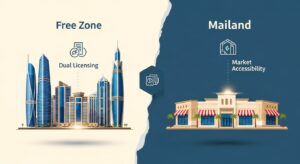
The landscape of UAE business operations has evolved significantly. A major development is the Dual License system, which serves as a bridge between the Free Zone and the local mainland market. This approach allows companies to maintain their Free Zone entity status—and the associated tax incentives—while simultaneously executing contracts and projects in the onshore market. This flexibility is a cornerstone of modern Business Registration, allowing firms to adapt to shifting market demands without dissolving their original legal entity.
Comparison of Business Setup Dimensions
This flexibility is a game-changer for businesses using The ADMM platform during Business Registration, as it allows for the integration of administrative services under a single digital umbrella. By reducing the necessity for manual registrations, companies can focus on scaling their operations rather than navigating fragmented bureaucratic requirements, ensuring a balance between speed and compliance.
Digital Transformation and The ADMM Impact
The role of platforms like The ADMM cannot be overstated in the current economic climate of 2026. As businesses demand faster, more reliable, and transparent services, these platforms act as the interface between the investor and the UAE government authorities. They provide an end-to-end solution for corporate services, including document translation, office space leasing, and license renewal management. By streamlining Business Registration, these platforms empower firms to execute functional strategies, maintaining an oversight of their legal and operational status.
Why Digital Platforms Are Essential
-
Efficiency: Automation reduces the typical setup time, significantly accelerating the time-to-market for new ventures through optimized Business Registration workflows.
-
Centralized Compliance: These platforms keep records updated in real-time, ensuring that companies remain in good standing with regulatory authorities by managing reporting requirements.
-
Scalability: As a company grows, digital platforms facilitate the addition of new business activities, office upgrades, or the hiring of additional personnel through simple online service requests, offering an approach to corporate expansion.
-
Data Security: Using encrypted, government-sanctioned portals protects sensitive corporate data, a top priority for international investors and technology firms undergoing Business Registration.
As the UAE business ecosystem continues to mature, the importance of choosing a partner that understands the nuances of Free Zone regulations becomes paramount. Whether an entrepreneur is launching a startup or expanding an existing international brand, the combination of Free Zone benefits and digital platform efficiency provides a foundation that is both stable and highly scalable. By adhering to the latest regulatory updates and leveraging available technological tools, businesses can thrive in one of the most competitive markets in the world, ensuring their Business Registration journey is defined by perspective planning and operational excellence.